Building An Anti-Bullying Culture at HVGS
In 2025 both the Federal and NSW Governments undertook significant reviews of anti-bullying strategies, structures and systems for schools. At the Federal level this work was the Antibullying Rapid Review undertaken by the Department of Education. This led to a series of recommendations which you can read here.
The recommendations articulate a commitment by the Federal Government to support states and schools to “empower and equip school communities to work together to prevent and address bullying and other harmful behaviours and build safe and positive environments”.
At a state level in 2025, the NSW Government worked with Professor Donna Cross to develop an Antibullying Framework for schools. This is an excellent framework that outlines a whole of school approach to and defines bullying. The key components of the framework are preventing, responding, partnering and implementing.
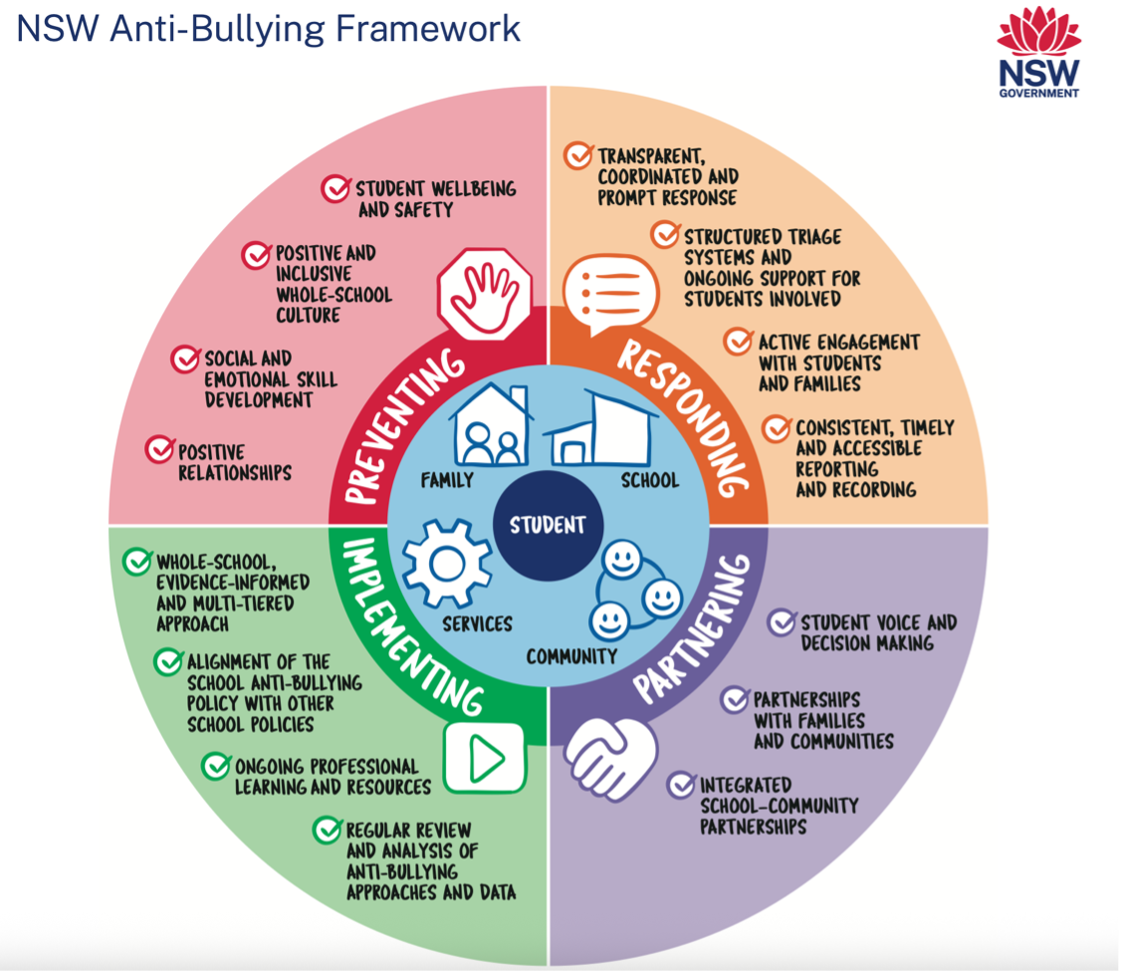
Prevention involves building a safe and positive environment which is foundational for learning. It is why two of the pillars of our strategic plan are Inclusion and Belonging and Connected and Flourishing Community. When feel like we belong and are respected for who we are (not who others want us to be), and that our perspectives and voices are heard, we are ready to learn and are resilient enough to take on the challenges of the “Learning Pit” (the journey of struggle and uncertainty we all go through when we learn something new). Likewise, when we feel connected to each other, we know how our voices can be heard and we understand that “other people with their differences, can also be right”. (see IBO Mission).
Crucially prevention involves building the skills of our students and staff that foster positive relationships. This is why we are in partnership with Real Schools to build and sustain a restorative culture at HVGS. Building the competencies of staff and students to acknowledge when harm has occurred, repair this harm and then modify behaviours to minimise the risk of this harm occurring again, is key to creating positive relationships across schools.
Excellence in holistic education is another of our strategic pillars which highlights the importance of educating the whole child. At HVGS we are committed to more than the academic development of your children - we want them to be good human beings and active, informed and compassionate citizens.
In the Anti-Bullying Rapid Review recommendations from the Australian Government there is also this recommendation:

Preventing and addressing bullying in schools can only be achieved through strong community partnerships to ensure a shared understanding of what is bullying and how best it can be prevented and addressed in schools. It also means we all – as adults – need to model the behaviours that foster an antibullying culture. This means in schools when we talk about bullying, we need to consider not only student to student interactions, but parent and staff interactions as well as staff and student interactions. In an age of “keyboard warriors” and global conflict, there was never a more important time for a school-wide and society-wide focus on antibullying.
At HVGS our school values, Community Charter, Behaviour Response Continuum and school policies make it clear what behaviours we expect across the school community. Clear behaviour expectations mean we can respond to breaches of these expectations in an appropriate way. We also always consider whether behaviours are developmentally appropriate. Children in our ELC and Stage 1 (Kindergarten to Year 2) are still learning behaviour and emotional regulation. Physical behaviours in these age groups will be dealt with differently than students in Years 3-6 where we would have different expectations about a child’s capacity for impulse control and emotional regulation. We also consider whether the behaviour is one-off or systemic, and other contextual factors (what might be happening for the child at home or within the friendship group for example). This means that responding to allegations of bullying can be complex.
Social conflict or disharmony in a friendship group on its own does not constitute bullying. Bullying is a distinct definition, and the NSW Antibullying Framework defines it in the following way:
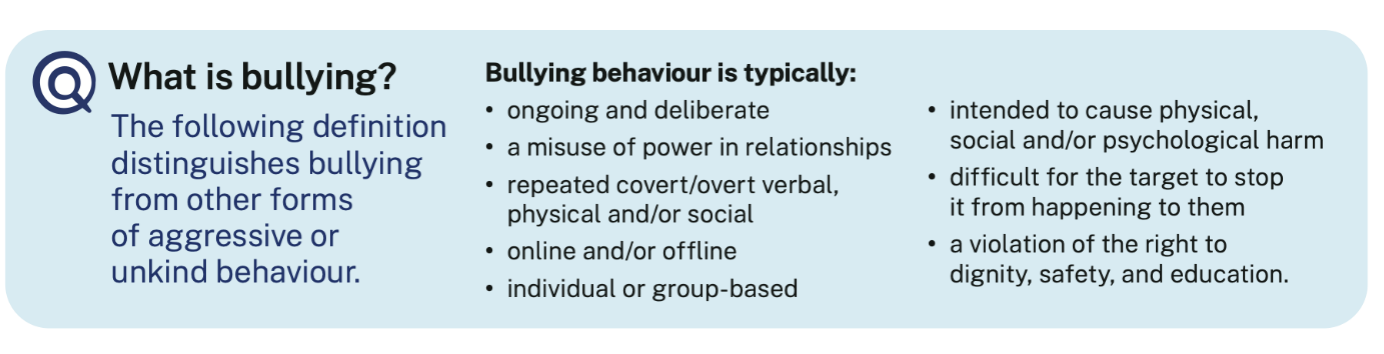
HVGS’ response to allegations of bullying takes this into account: the behaviours need to be ongoing and deliberate, and there needs to be evidence of this. Bullying also involves a power difference, an intention to cause harm and the target will usually feel powerless to stop it from happening to them.
During 2026 we are looking forward to working with staff, students, parents and carers on sustaining a whole school approach to anti-bullying that focuses on ensuring we feel connected and a sense of belonging. Together we ensure that HVGS remains a safe place where all students can thrive and learn to be the compassionate, caring and inclusive human beings.