Is My Child Really Engaged In Learning?
As parents, we want our children to do well and thrive. We want them to be in the “flow” with their learning, co-curricular activities and life in general. If they are not, we have plenty of wonderful advice on how they can get there! Often this advice is about doing more, trying more things or just working harder. And there is nothing more frustrating than watching your child “waste their potential” as they roll their eyes and tell us that “we just don’t understand”.
And to be honest, we often do not. As adults, we understand engagement and a strong work ethic in a certain way. We make assumptions about what it looks like to be thriving and become critical and solution-focused when our children display behaviours that do not match what we expect.
Conversely, we are quick to praise those behaviours that match our expectations, thereby misreading compliance for engagement. In The Disengaged Teen by Jenny Anderson and Rebecca Winthrop, they write that the “opposite of boredom is not being busy, it’s being interested.” (p.22)
But we are busy parents and so find it hard to get out of fixing mode and pause to ask ourselves these questions:
- What does authentic and deep engagement in learning look like for my child?
- How might it be different than what it looks like for me as an adult?
- What might I see my child doing and hear them saying if they are thriving in their learning?
In December last year, I read The Disengaged Teen by Jenny Anderson and Rebecca Winthrop, and it transformed my thinking about agency and engagement. It was so transformative, I shared the book and key ideas with staff, and we now have a group reading it and applying it to their work.
The concept of a disengaged teen can feel synonymous with adolescence. Isn’t it a characteristic of being a teenager to be slightly disaffected and disengaged? Anderson and Winthrop challenge this notion. Their book outlines that it is not inevitable; teenagers are not victims of their own affect, and adults do not really understand as much about deep engagement as we think we do.
Due to the assumptions we make about what engagement looks and sounds like, we sometimes misread compliance as engagement and limit children’s ability to grow into truly autonomous adults. This is where the book stopped me in my tracks!
Anderson and Winthrop codify engagement into four modes:
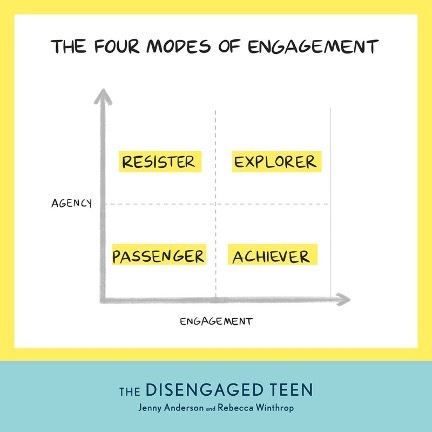
Passenger Mode
Imagine being on a long-haul flight at the start of a holiday. You have your book, you have the screen in front of you, and you have someone bringing you food and refreshments. The headphones go on, and you are quietly sitting. You are in cruise mode, and you ask little of yourself, and others ask even less of you (with the exception of very young children if you are travelling with them). This is passenger mode.
For a teenager in passenger mode, they are not quietly sitting; they are “quietly quitting”. This is the child “coasting in neutral”. They may do the bare minimum; they might have a few co-curriculars that they do, but generally they appear passive. A child in this mode complies “with school requirements but never does more than what is asked of them” (Anderson & Winthrop, 30). They will do the minimum amount of work for assignments while having endless energy for their favourite video game or sport. Apparently, everything is boring, and when you ask your passenger child about their day, their usual response is “fine”.
You might often read this type of comment in a passenger student report card: “Bobby is performing below potential and should strive to go beyond the requirements of a task.”
This is the most common mode of disengagement. These students do not rock the boat too much, so they rarely draw the attention of staff beyond an irritation or frustration with their lack of work ethic. Often these students stay within their comfort zone of learning, and this is the crux of the issue. They are not thriving; they are just surviving. Being a passenger may be a way to mask the struggles they are having, or they may not have the confidence to step into their growth zone. These students often feel like learning and life is happening to them. They lack both agency and engagement.
Resistor Mode
Resistors have the same feeling - school and home life is done to them. However, unlike passengers, resistors have a sense of agency and display this by actively driving in reverse. These students are often most visible in the classroom as they can display either disruptive behaviours or such active disengagement they become unresponsive.
The good thing is that we see and hear resistors in our classrooms and homes, but their “agency is deployed in the wrong direction - away from learning, not towards it.” (Anderson and Winthrop, 93).
These students are vulnerable because they can feel that others are setting them up for failure if they do not know how to succeed, or anger at what they consider an irrelevant task. Resistors can feel powerless, and with that, their emotions become visible.
Achiever Mode
Achievers are the group we often hold up as paragons of engagement. Achievers are driven by the external metric of success, which is wonderful if that metric fits within one’s grasp. At the extreme end, achievers can be hyper-focused on getting things just right and find it difficult to encounter new and unfamiliar situations for which they don’t have an easy answer.
In the classroom, an achiever student will ask lots of questions so they can get the assignment right or revise correctly for the exam. Failure is not a space of comfort, which can lead to avoidance of learning experiences that are unfamiliar or out of their comfort zone. Achiever parents and students often face the “Achiever Conundrum”; that is, “they want their kids to push themselves, but they don’t want them to break” (Anderson & Winthrop, 81).
Teaching achievers is wonderful and at the same time deeply frustrating. They are cognitively engaged in learning, driven and mostly active in the classroom. However, this is often motivated by external factors: parent or teacher approval, competition with a highly able peer, or good grades.
As a result, when the external scaffolds are removed, a teenager in achiever mode can feel untethered and directionless. They are yet to learn the innate curiosity that leads to lateral thinking, creative problem-solving and true independence and autonomy.
Explorer Mode
The explorer, in Anderson and Winthrop’s matrix, “takes ownership over their learning” (Anderson & Winthrop, 111) and “will develop critical mindsets and abilities: creating, questioning, thinking independently.” Explorers look for “ways to make life meaningful” and are intrinsically motivated. Failure is ok and an explorer will try out a task even if they do not have explicit instructions on how to get it right. There is an agility, adaptability and resilience about explorers as their innate curiosity means they try things, realise what they do not know, fail a bit, and understand that this is a temporary state.
Being an explorer sounds like an ideal state.
The reality is that we (children and adults alike) move in and out of passenger, resistor, achiever and explorer modes depending on the context. The goal is to build our awareness of which state we are in, and a level of intentionality about what state is most appropriate at this point in time. One of the purposes of schooling is to expose students to a wide range of disciplinary thinking and skills so they can uncover their passions as well as build their capabilities. Teenagers will make choices to cruise in some classes, while investing heavily in others. Sometimes they will focus on being achievers so they can get the grade for a course they need for university entrance.
All this is ok, what is important is to recognise when a student or child is stuck in one mode and to ensure we are intentionally building high engagement and high agency in schools and our homes.
Anderson and Winthrop write that...
“…engagement is a complex interplay of emotions, thoughts and behaviours that ignite a deep, genuine interest in the world around us. When children are engaged, they are energised not exhausted. They become pro-active learners. They ask questions, seek help, advocate for their interests, and learn to set their own goals… In other words, more engaged kids learn better, perform better, feel better, and live better.” (p 16-17)
“The ability to engage deeply in learning, to have a say in how they spend much of their significant mental energy, is not a nice-to-have but a must-have. It is the price of entry for a meaningful life, whatever they choose that life to be.” (p.18)
This is the crux of the matter. We want all children - most particularly our teenagers, where disengagement can appear the norm - to spend the majority of their time deeply engaged. I want our teenagers to be as energised in the classroom as they are on the football field or on the stage. They do not need to be always on, but we do need to teach them the skills and competencies to be pro-active learners.
Someone once said to me that parenting is one of the cruellest things we do to ourselves. We love our children; they become our lives, we become as dependent on them as they are on us, and we expend an incredible amount of energy (and financial resources) to help them become the best version of themselves. We do this so they can separate from us and become independent, autonomous adults who no longer need us. They will love us but be thriving adults living their own lives.
The most wonderful gift we can give to our children is to let them be in the driver’s seat. We need to step back, let them advocate for their own interests and set their own goals, and fail along the way. By doing so, we help our children become explorers with the skills to live meaningful lives separate from ourselves.
References:
Anderson, Jenny, and Rebecca Winthrop. The Disengaged Teen: Helping Kids Learn Better, Feel Better, and Live Better. Vermilion, 2025.