Students in Resistor Mode
Recent research from the Centre for Independent Studies found that Australian teachers lose “almost one third of lesson time to student misbehaviour, equivalent to about 12 weeks of learning each year.” (source). Another key point from the study was that “frequent low-level disruption, rather than extreme misconduct, repeatedly interrupts teaching and reduces students’ learning time”. In fact, according to the study of 377 teachers, the average amount of time lost per 30 minutes was 9 minutes. In an ABC interview, the author of the study, Blaise Joseph, goes on to describe this as a “crisis” (source). One of the high-level recommendations from the study was the implementation of “explicit behaviour curricula” involving “clear routines, expectations and consequences”.
The study is an interesting one that would resonate with many educators. At HVGS strong classroom routines and clear expectations of student behaviour are part of our “way of working” and still disruptive behaviour can slip through the cracks.
Studies such as the one from the Centre of Independent Studies surface the problem, give validity to the importance of structure and clear boundaries in our classrooms and add weight to the challenges facing educators at the coal face of learning.
However, they do little to get to the root cause of disruptive behaviour. The focus remains on the above the line behaviours that draw our frustration and attention. I would argue that two things can co-exist in our classrooms: a strong focus on structure, boundaries, expectations, and a curiosity about the antecedent events or moments that led to the disruptive behaviour.
One of the most common complaints in schools is from parents about other students disrupting their child’s learning. This is completely understandable based on the data cited above. Our role as educational leaders is to investigate the concern, put in place interim measures to address the issues we have uncovered, then get to the root cause for the behaviour and implement strategies aimed at long-term change.
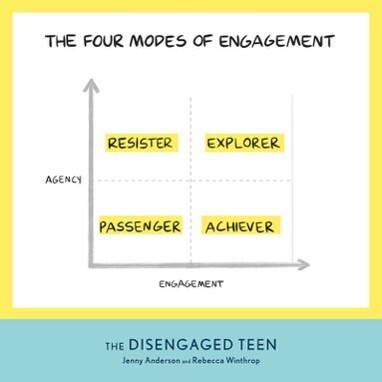
Coming back to Anderson and Winthrop’s notion of modes of engagement (see previous blogposts and the graphic below), the students about whom teachers and parents complain - and the ones leading to such high numbers in Joseph’s study - are typically students in Resistor Mode.
Students in Achiever Mode, as outlined in a previous blogpost, are motivated by accolades and recognition of their achievements or performance. Any student can move between modes at any time but typically a student who defaults to Achiever Mode thrives on positive feedback and will behave in class. Those in Passenger Mode, are in cruise control and while they may not actively engage in the learning process, they are rarely the disruptors.
Students in Resistor Mode, by contrast, exercise a high degree of agency (they are not passive) either by actively resisting through disruptive behaviours or withdrawal from the learning process entirely. These students are often very visible in our classrooms. Their presence is felt by students and teachers. The classroom can feel like a different place when they are not present. Therefore, they are students we can struggle to feel empathy for or stay curious about.
However, this is just what students in Resistor Mode need - genuine curiousity and the suspension of judgement as a means of getting below the line and finding out the root cause for their active disengagement from learning.
Students in Resistor Mode may not be that way in all subjects, with all teachers or at all times of the day. They may be students with a diagnosed learning need, or they may not.
Most certainly they are students who don’t understand the purpose of the learning and who likely do not have the skills to master the learning before them. Ross Green, a psychologist, has written a book I recommend all parents to read. Its title is Lost at School and it is written with students in Resistor Mode in mind! Even if your child tends towards one of the other engagement modes, Lost at School is a powerful read that can support a cognitive shift in thinking about learning.
A key principle for Ross Green is that all students ultimately want to do well, and they are looking for positive recognition from adults. When students become disruptive, Green argues that it is usually because they are lacking a specific skill. There is something they are required to do in the classroom that they cannot do yet. Understanding what this skill is, and putting the right interventions in place, comes from being curious and the child working with the right adult working on a regular basis.
I like this concept because it encourages us to see the behaviour as a symptom of something else lying just below the surface. Often the student cannot yet put their finger on what that something is, but with the right educator with a curious mindset it can be uncovered.
This is the piece missed by Blaise Joseph’s paper. His answer is a simple one: implement a behaviour curriculum. Most schools I speak to would say they already have strong behaviour policies and frameworks for responding to behaviour. What most educators and schools struggle with are the students in Resistor Mode who are making an active and visible choice to disengage. These students often know what is expected of them but may not yet have the skills to fulfill those expectations. Therefore, they don’t see themselves ever being successful in the learning. This can lead to those disruptive behaviours or active withdrawal that is equally concerning.
Joseph’s paper though does hold another implicit warning: disruptive behaviour draws the attention of the educator and it means we can miss the students in unhappy Achiever Mode or in Passenger Mode. The answer? Build our understanding as educators and parents/carers of the different modes of engagement so we can recognise the telltale signs and work together, with students, to break the pattern of thinking and behaving that is characteristic of that mode.
In the meantime, we also need to reflect on the learning that is happening in our classrooms and the ways in which we are creating opportunities for positive and constructive student agency. A student who feels some control of their learning, is less likely to resist that learning. Therefore they will be more open to getting below the line and uncovering what it is that makes it so hard for them to demonstrate mastery of what matters in the classroom.
References:
Anderson, Jenny, and Rebecca Winthrop. The Disengaged Teen: Helping Kids Learn Better, Feel Better, and Live Better. Vermilion, 2025.
Joseph, Blaise. Classrooms in Crisis: Australian Teacher Views on Student Behaviour. Centre for Independent Studies, 3 Sept. 2026, https://www.cis.org.au/publication/classrooms-in-crisis-australian-teachers-perspectives-on-student-behaviour/.
Duffy, Conor, and Miwa Blumer. “One-Third of School Time Lost to Student Misbehaviour, Report Finds.” ABC News, 2 Sept. 2026, https://www.abc.net.au/news/2026-09-03/one-third-of-lesson-time-lost-to-misbehaviour-teachers-say/107101894.