Kids Achiever Mode
In my last blogpost I introduced a great book called The Disengaged Teen by Jenny Anderson and Rebecca Winthrop. In the book, they identify four modes of engagement:
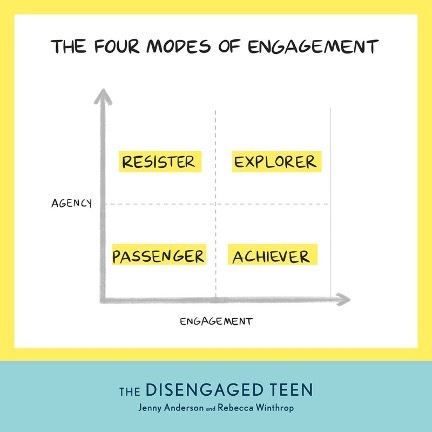
In this post I will explore Achiever Mode. The subtitle of the relevant chapter in Anderson and Winthrop’s book is “the perils of perfection”, which is probably a giveaway for the dark side of Achiever Mode.
Firstly, I want to tell a story about Rachel. Rachel worked hard at school, did well academically and was quite competitive. Her archrival in Year 12 excelled across the board academically and they “fought it out” for dux (her rival won in the end). Rachel’s passions were English and History and she won the academic award for English, was school captain, captain of the netball and athletics teams, and loved school! Amongst her cohort of Year 12 students, Rachel was known and respected. Staff enjoyed having her in their classes as Rachel engaged in the learning, answered questions in class, worked hard and met deadlines (mostly). As school captain, Rachel represented the school at key events.
Rachel was an achiever. She knew what success felt like and rarely experienced failure of any significance. Going to university, Rachel felt assured that success was on the horizon – that she would continue to be an achiever in her English literature and History studies. In fact, failure was not an option or part of Rachel’s vocabulary.
Until Rachel submitted her first essay at university. It was an English essay, and Rachel had worked hard to analyse the text and write with her usual flair and passion. However, the marker did not see it that way and the essay came back with barely a passing grade and comments that were direct and critical. Rachel was shocked and incoherent. Her world was rocked along with her sense of self. The lengthy feedback provided couldn’t be read or digested as all Rachel saw was failure and the feeling of shame was overwhelming. There was no learning that could happen and Rachel fell into a hole, handed her next paper in late and received an equally brutal mark.
Rachel slipped into “unhappy achiever mode”. Anderson and Winthrop share that there is a fine line between happy and unhappy achieving. As a parent, it is a bit like walking a tightrope with a high achieving child: “When students spend too much time in Achiever mode, it can become an identity”. (58) Anderson and Winthrop go on to say that:
“Kids who spend too much time in Achiever mode risk failing to develop their own creativity. It’s hard to think of an original way to do something when so much energy is spent getting the right answer. …
Being the smart one translates to a certain confidence. But there can be an unexpected downside, when too much achieving makes kids fragile, unwilling to take risks for fear of failure.” (58)
For parents this leads to the “Achiever Conundrum” - we want our children to do well and have a strong work ethic, but this can harm them. Pushing oneself into a growth or learning zone is great, provided we don’t break. It is the same for our children.
What we must be mindful of is that children in achiever mode can become so focused on pleasing adults in their lives, or being better than other students, that they forget about just being.
They can also be so focused on achieving the external, positive reinforcement they crave, that they lack intrinsic drive and motivation in the absence of external praise and acknowledgement. This might be the student who thinks (or says) if there is no prize at the end, why bother?
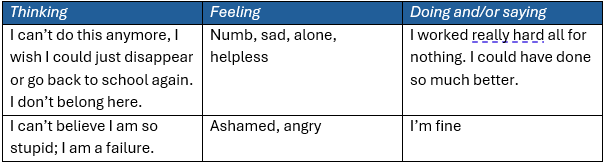
How might we know our children are in unhappy achiever mode?
We need to listen to what they are saying, see what they are feeling, and consider what behaviours and ways of being we are reinforcing through our praise and feedback. If we were Rachel’s parent, here is what unhappy achiever mode may have looked and sounded like:
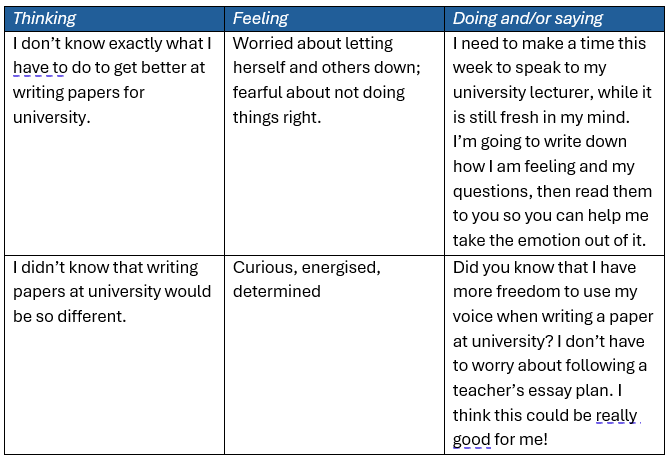
In contrast, happy achiever mode for Rachel might look and sound like this:
What can we do as parents to help your child stay out of unhappy achiever mode?
Firstly, don’t over schedule your child. If your child has no moment to breathe, to pause, to reflect because they are bouncing from one enrichment or co-curricular activity to another, they correlate being busy and doing with achieving. They also have no time to play and explore and thereby discover more about themselves and what they are passionate about. Over-scheduled children often lack autonomy and the ability to make decisions for themselves or to know what they are really want. This is because they are used to others doing things for them.
Secondly, make sure your words and actions align. For instance, you might say that grades don’t matter, you just want your child to be happy. However, you put that straight A-report card on the fridge or post about it on social media. Kids are savvy and in that moment, they know that grades do matter to you, even if you say they don’t! What happens when they don’t get straight As, will the report card still go on the fridge or be posted about on social media? When we focus on the grade or winning, we lose focus on the learning that happened. We need our children to know that it is ok for them to engage in productive struggle and not be perfect all the time.
Thirdly, don’t try and solve your children’s problems for them. If we hover too much and jump in quickly to solve that friendship issue or ask the teacher to help our child rather than helping our child figure out how to ask for help themselves, we take away their agency. Each time we hover too closely and solve our child’s problems for them, we make our children less resilient. Remember, mistakes are great learning opportunities! Our children are great at bouncing back if we give them a chance to do so. Unhappy achievers often lack resilience because we haven’t let them fail and so when they do, it feels shameful and they lack the resources to climb out of the Learning Pit.
We all love being in achiever mode. We feel productive, connected to the learning and receive the recognition we crave. However, it is a fine line for our children and for us as adults. Many of you will be high achievers and expect the same for your children.
Full disclosure the story of Rachel is my story, with some creative license. I remember that moment at university like it happened yesterday. In the moment I felt all those emotions, and likely for most of the semester. But I also became determined to turn things around. I loved what I was studying and for the first time I realised that in English I was no longer the smartest in the room, and I needed to lean into that challenge and how it made me feel. I learnt to embrace struggle and became a better thinker and writer as a result.
As parents we need to model being in the learning zone. We don’t need to be there all the time – that would be exhausting. However, if our child tends to be in Achiever mode most of the time, they likely prefer to be in the Performance Zone (see below). In this zone they are at their best; in the learning zone they are feeling stretched. A child in unhappy achiever mode, can’t really access the learning or aspirational zones that are so key to growth.
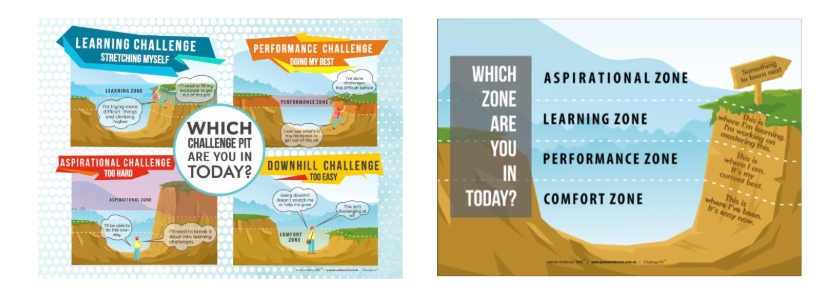
The above graphics from James Anderson provide a wonderful conversation starter for the dinner table or over a weekend breakfast. Ask your children to reflect on which challenge pit they might be in for a particular subject and what it might look like to be in the learning zone. You can go first and model it! Share an example of where you are in the learning zone and what you love about being there. Our children will learn through your example, and it is a powerful way to help your child navigate the wobbly Achiever Mode tightrope.
References:
Anderson, Jenny, and Rebecca Winthrop. The Disengaged Teen: Helping Kids Learn Better, Feel Better, and Live Better. Vermilion, 2025.